

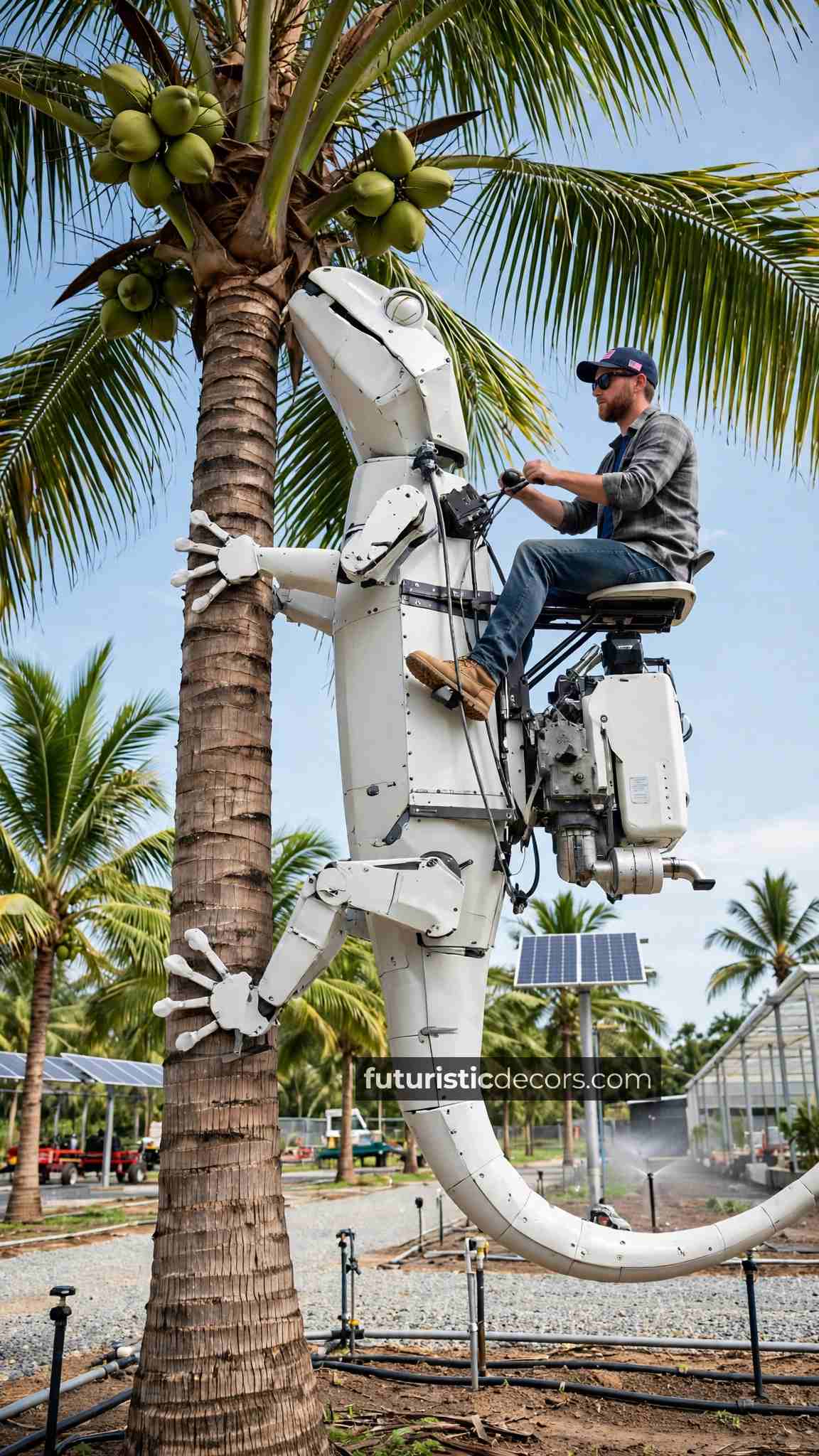
Enter the robot gecko coconut harvesting, a bio-inspired agricultural machine designed to tackle vertical palm trunks safely, steadily, and efficiently. By combining gecko-inspired climbing mechanics with modern robotics and precision harvesting tools, the Gecko Coconut Harvesting Robot reimagines how farms gather ripe fruit without putting human lives on the line.
Whether built in a sleek cream finish, a crisp white shell, a bold red frame, or an eye-catching rainbow coating, this concept shows how nature-driven engineering can modernize one of tropical agriculture’s toughest jobs!
Why Traditional Coconut Harvesting Needs a Smarter Solution?
Coconut palms are iconic features of tropical landscapes, yet their tall, segmented, and often curved trunks make harvesting notoriously difficult. Unlike orchard trees that growers can prune low or reach with standard ladders, mature coconut palms routinely soar well above ground level, with heavy clusters of nuts resting near the crown.
Safety Risks at High Altitudes
Climbing a palm trunk demands upper-body strength, leg endurance, and constant focus. Bark textures vary from rough and ringed to damp and slippery after rain, while fronds and falling debris add extra hazards overhead. Falls from tall trees remain one of the most serious occupational dangers in tropical farming.
Even when workers use climbing gear or semi-manual frame climbers, fatigue sets in quickly over a full workday, increasing the chance of mistakes.
Rising Labor Shortages and Costs
Across many farming regions, fewer young workers are willing to train as traditional climbers. That scarcity drives up labor rates during peak harvest windows and forces growers to wait longer for available crews. Delays can mean missed harvest timing, uneven fruit maturity, or higher post-harvest handling costs.
A Gecko Coconut Harvesting Robot helps bridge this gap by offering a repeatable, tireless climbing platform that supports farm productivity without relying solely on scarce high-altitude climbers.
Tree Health and Trunk Diversity
A good harvesting method must protect the tree as much as the worker. Heavy clamps, harsh spikes, or poorly balanced rigs can scar delicate trunk tissue or stress leaning palms. Coconut trees vary widely in diameter, taper, height, and tilt angle—some grow straight as pillars, while others lean noticeably toward open sunlight. Adapting to these differences is essential for any practical climbing system.
“You’ll find links to similar products at the end of this article!”
How the Gecko Coconut Harvesting Robot Works
Geckos are famous in biology and robotics for their ability to scale vertical and irregular surfaces with remarkable control. Rather than relying on brute force alone, gecko-inspired locomotion pairs coordinated limb movement, balanced weight distribution, and tailored surface grip.
Bio-Inspired Grip and Limb Coordination
A climbing machine on a coconut trunk faces two constant challenges: resisting gravity and accommodating uneven bark rings. A robot gecko coconut harvesting uses multi-limbed or articulated gripping structures that sequence contact points smoothly as the body advances upward. Key mechanical traits include:
- Articulated limbs and digits that conform to curved trunk contours and segmented bark ridges
- Alternating grip-and-step cycles that keep weight anchored while individual limbs reposition
- Tail or rear stabilization that helps counteract pitch, sway, and outward leverage away from the trunk
- Controlled compliance that adjusts to slight changes in trunk circumference from base to crown
Powertrain, Control, and Operator Interface
Climbing a tall palm requires steady torque without excessive weight. Excess mass demands bigger motors and larger batteries, which in turn add more weight—a classic engineering trade-off in climbing robotics.
Depending on the design configuration, a Gecko Coconut Harvesting Robot can pair compact high-torque actuators or an onboard engine/power unit with responsive control levers, a remote controller, or a wireless ground interface.
Operators can monitor progress from a safe distance on the ground or guide movements directly while maintaining clear sightlines. In more advanced autonomous or semi-autonomous setups, cameras and vision models help spot mature coconut bunches amid dense fronds so the cutting mechanism targets the right stem.
Precision Harvesting at the Crown
Reaching the top is only half the job; detaching bunches cleanly is where agricultural value happens. Once positioned near a cluster, a robot gecko coconut harvesting aligns a cutting arm or blade assembly with the fruit stem.
By severing the stem cleanly rather than yanking or twisting violently, the machine helps reduce damage to nearby developing nuts and emerging fronds. Ground crews can then collect fallen coconuts from a safe perimeter, keeping workers clear of the drop zone.
Core Benefits for Coconut Growers and Farms
Adopting a Gecko Coconut Harvesting Robot is not just about novelty—it is about practical operational advantages across daily farm routines.
Safer Operations Across Tall Palms
Removing people from high-risk climbs fundamentally changes farm safety profiles. Even when an operator oversees a robot gecko coconut harvesting on-site, staying out of the canopy eliminates fall hazards associated with high-altitude climbing. Safety interlocks, controlled descent modes, and fail-safe holding mechanisms further protect both the machine and the palm if power dips or a control signal weakens.
Consistent Pacing and Reduced Fatigue
Human climbers naturally slow down as muscles tire over hours of climbing. A Gecko Coconut Harvesting Robot maintains steady climbing rhythm from the first palm of the morning to the last palm of the afternoon. Farmers can plan harvest schedules with greater predictability, especially on plantations with hundreds or thousands of mature trees.
Better Access to Difficult or Leaning Trees
Some palms grow on sloped ground, narrow rows, or awkward angles where conventional equipment cannot reach. A nimble Gecko Coconut Harvesting Robot can approach trunks directly and scale upward regardless of surrounding ground obstacles, making previously awkward trees easier to harvest on schedule.
Design Variations: From Sleek Neutrals to High-Visibility Finishes
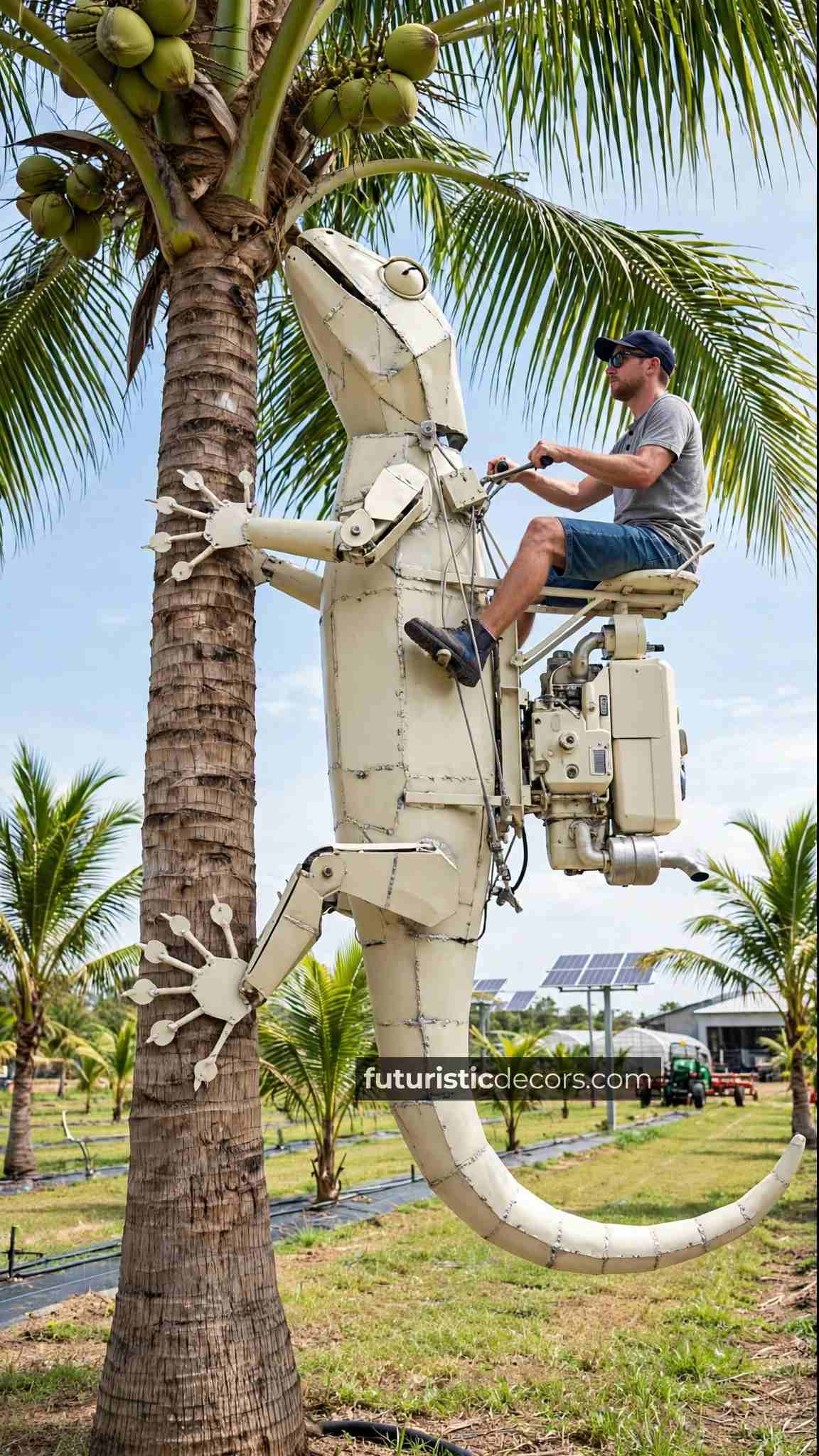
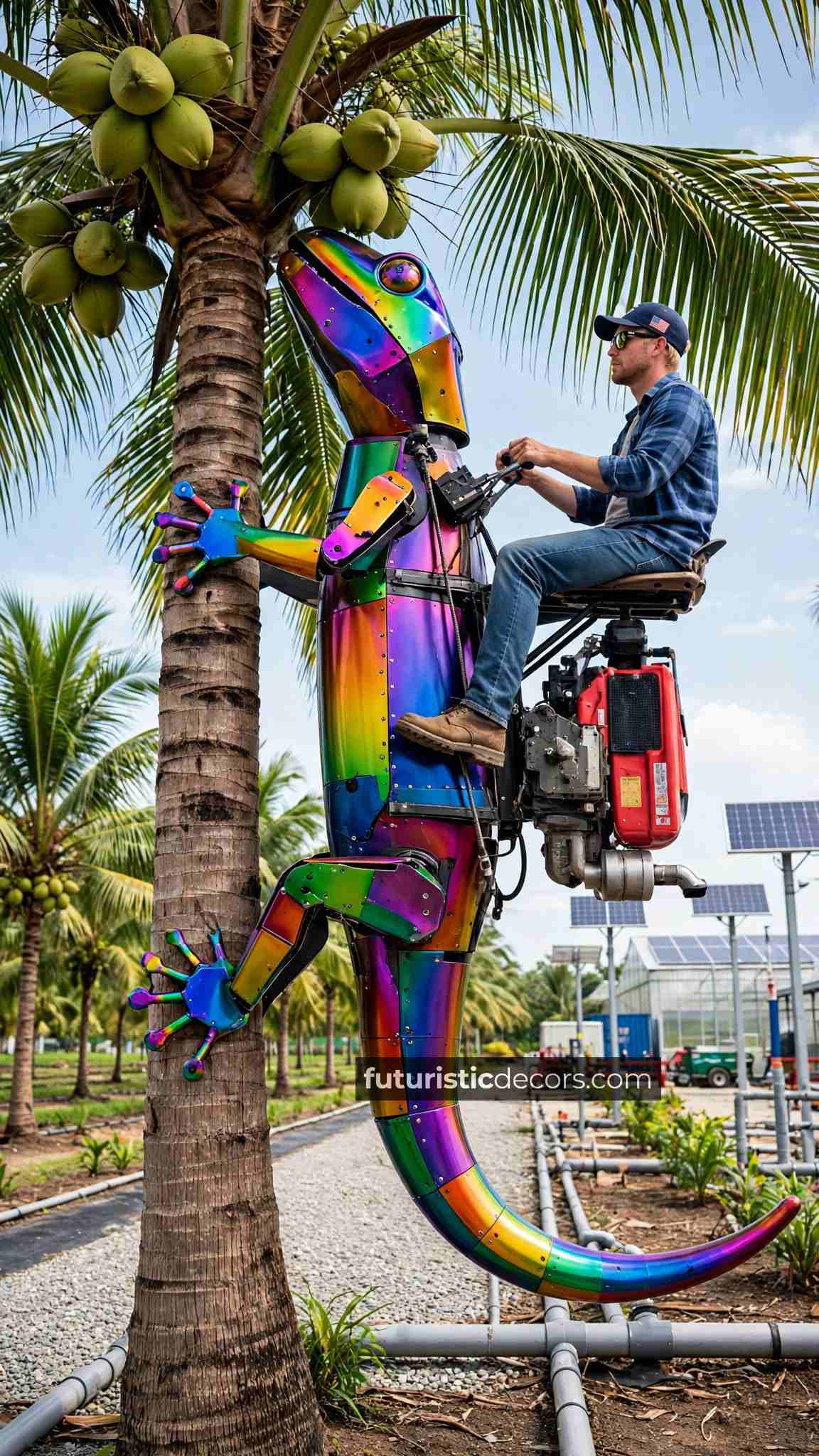
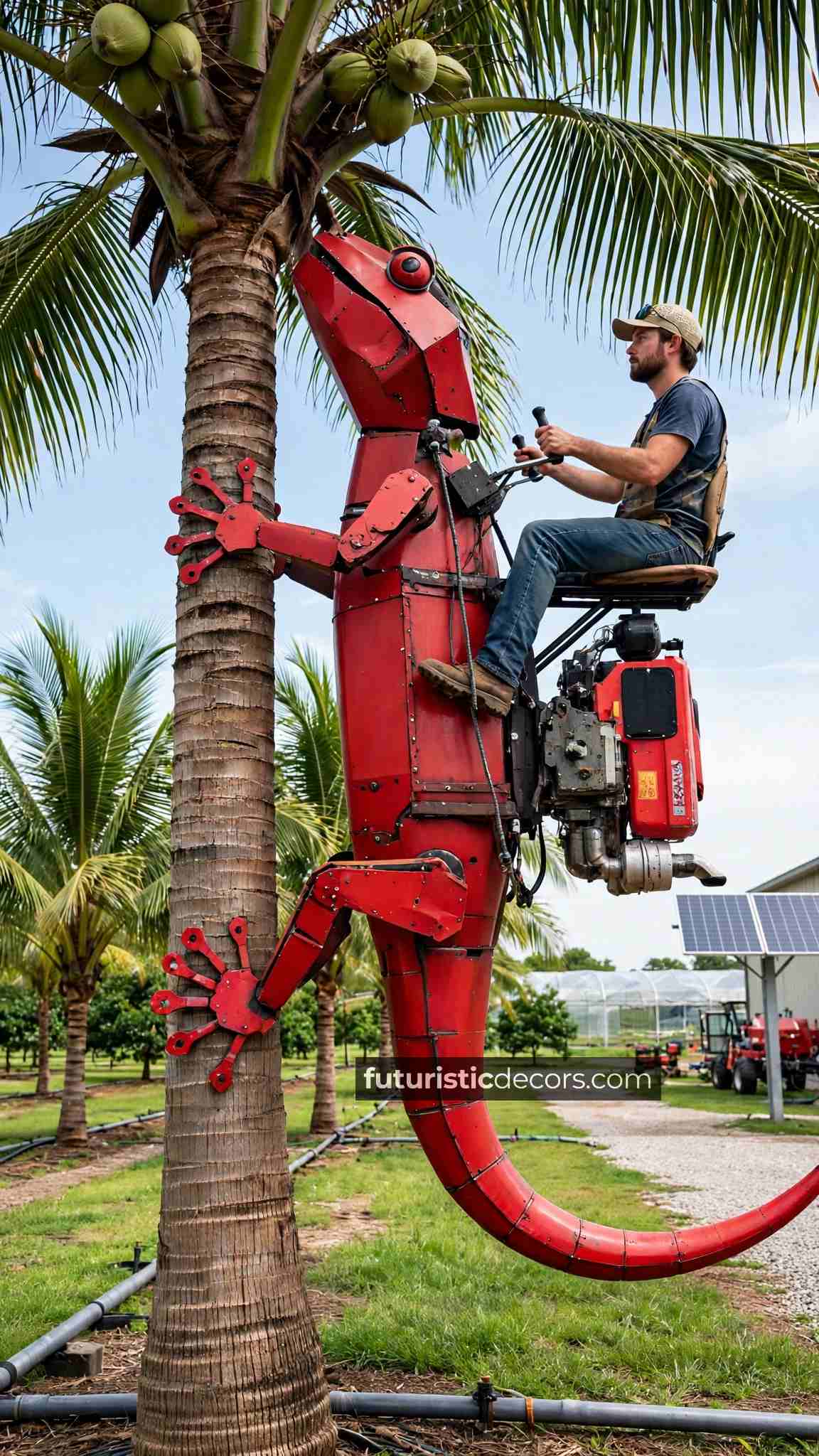
Visual design in field robotics serves both practical and branding purposes. Look at the four visual variations of the Gecko Coconut Harvesting Robot—cream, rainbow, red, and white—and each highlights a distinct way a farm or manufacturer might position the machine in real-world orchards.
Cream and White: Clean, Heat-Reflective Utility
Cream and white finishes give the gecko coconut harvesting robot a clean, engineered look that reflects sunlight well under strong tropical rays. Lighter exterior panels can help reduce surface heat buildup during midday operation, while crisp contrast makes structural joints, cables, and mechanical linkages easy to inspect during routine maintenance checks.
Red: High Visibility in Dense Green Canopies
Bright red stands out sharply against green palm fronds, sunlit trunks, and shaded farm paths. High-visibility red paneling on a Gecko Coconut Harvesting Robot makes it easy for operators to track position and orientation from the ground, even when working near dense foliage or moving equipment.
Rainbow: Standout Identity for Demos and Agritech Showcases
A vibrant rainbow finish turns the Gecko Coconut Harvesting Robot into an instant crowd-pleaser at agricultural expos, university labs, pilot demonstrations, and farm open days. While practical farm work favors durability and easy touch-up coatings, eye-catching colors help spark conversation around modernizing traditional farming and attracting young talent to agricultural engineering.
Practical Challenges and Engineering Realities
Every promising agricultural robot faces real-world hurdles outside the workshop. Bringing a robot gecko coconut harvesting from concept or prototype to everyday field reliability requires solving several practical engineering challenges.
Rough Bark, Debris, and Weather Exposure
Coconut trunks are rarely clean laboratory test poles. Rain, sap, dust, lichen, loose fibers, and occasional insect nests all affect traction and mechanical wear. Seals, bearings, actuators, and gripping surfaces on a Gecko Coconut Harvesting Robot must resist moisture, grit, and vibration without jamming or losing grip mid-climb.
Weight, Energy Storage, and Turnaround Time
Battery capacity, fuel efficiency, and payload weight are tightly linked on any climbing machine. If a robot gecko coconut harvesting is too heavy, climbing consumes excessive energy and limits how many trees it can harvest before recharging or refueling. If it is too light, wind gusts or cutting forces can destabilize it near the crown. Balancing structural strength with energy efficiency remains a central design priority.
Cost, Maintenance, and Field Serviceability
For smallholders and medium-sized farms, affordability and ease of repair matter just as much as peak performance. A Gecko Coconut Harvesting Robot needs modular parts, accessible fasteners, and straightforward diagnostics so technicians or trained farm staff can swap worn pads, check cables, and keep downtime low during peak harvest season.
How Farms Can Prepare for Robotic Coconut Harvesting
Even before adopting a full robotic fleet, growers can take practical steps to get ready for a Gecko Coconut Harvesting Robot and similar field technologies.
- Map trunk profiles and tree heights: Note average trunk diameters, lean angles, and canopy heights across blocks to match machine reach and grip ranges.
- Keep ground drop zones clear: Maintain clear sightlines and safe perimeter spacing beneath trees during harvesting to protect workers and equipment.
- Standardize harvest maturity checks: Establish clear visual cues for ripe versus tender nuts so operators or vision systems cut the right bunches.
- Plan charging, fuel, and maintenance routines: Set up a dedicated shaded staging area for power packs, spare wear parts, and daily post-shift inspections.
Discover comparable items here: Click here
Conclusion: “The Future of Tall-Trunk Harvesting”
Agricultural robotics is moving steadily from flat rows and greenhouses into complex three-dimensional environments like orchards and tall palm groves. As sensors become tougher, actuators grow more power-dense, and control systems become more intuitive, a Gecko Coconut Harvesting Robot points toward a future where climbing towering trunks no longer requires risking human life.
With continued refinement in grip reliability, energy efficiency, and serviceability, the robot gecko coconut harvesting can help coconut farms stay productive, protect workers, and keep a time-honored crop thriving for the next generation.